A Ticket to Adventure

      Roy J. Snell
     A Ticket to Adventure

Mary Hughes had walked the entire length of the long dock at Anchorage, Alaska. Now, having rounded a great pile of merchandise, tents, tractors, groceries, hammers, axes, and boxes of chocolate bars she came quite suddenly upon the oddest little man she had ever seen. Even for a girl in her late teens, Mary was short and slender. This man was no larger than she. "A Japanese," she thought as her surprised eyes took in his tight-fitting black suit, his stiff collar and bright tie. "But no, a Jap wouldn't look like that." She was puzzled and curious. At that particular moment, she had nothing to do but indulge her curiosity. Together with hundreds of other "home-seekers"--she smiled as she thought of herself as a home-seeker--she had been dumped into the bleak Arctic morning. Some of the goods that were being hoisted by a long steel crane from the depths of a ship, belonged to Mary, to Mark her brother, and to Florence Huyler her cousin. There was, for the time, nothing they could do about that. So--

Read online

  • 222

    Boy Allies at Verdun; Or, Saving France from the Enemy

      Clair W. Hayes
     Boy Allies at Verdun; Or, Saving France from the Enemy

CHAPTER I THE EVE OF VERDUN On the twenty-second of February, 1916, an automobile sped northward along the French battle line that for almost two years had held back the armies of the German emperor, strive as they would to win their way farther into the heart of France. For months the opposing forces had battled to a draw from the North Sea to the boundary of Switzerland, until now, as the day waned—it was almost six o'clock—the hands of time drew closer and closer to the hour that was to mark the opening of the most bitter and destructive battle of the war, up to this time. It was the eve of the battle of Verdun. The occupants of the automobile as it sped northward numbered three. In the front seat, alone at the driver's wheel, a young man bent low. He was garbed in the uniform of a British lieutenant of cavalry. Close inspection would have revealed the fact that the young man was a youth of some eighteen years, fair and good to look upon. As the machine sped along he kept his eyes glued to the road ahead and did not once turn to join in the conversation of the two occupants on the rear seat. Whether he knew that there was a conversation in progress it is impossible to say, but the rush of wind would have made the conversation unintelligible, to say the least. This youth on the front seat was Hal Paine, an American. The two figures in the rear seat were apparently having a hard time to maintain their places, as they bounced from side to side as the car swerved first one way and then the other, or as it took a flying leap over some object in the road, which even the keen eye of the driver had failed to detect. But in spite of this, even as they bounced, they talked. One of the two figures was tall and slender and there was about him an air of youthfulness. He was in fact a second American boy. His name was Chester Crawford, friend and bosom companion of Hal Paine. Like the latter he, too, was attired in the uniform of a British lieutenant of cavalry. The second figure in the rear seat was built along different lines. He was short and chunky; also, he was stout. Had he been standing it would have been evident that he was almost as wide as he was long. He had a pleasant face and smiled occasionally, though upon each occasion this smile died away in a sickly grin as the car leaped high in the air after striking a particularly large obstruction in the road, or veering crazily to one side as it turned sharply. In each case the grin was succeeded by a gasp for breath. The figure was that of Mr. Anthony Stubbs, war correspondent of the New York Gazette, on the firing line in Europe to gather facts for his newspaper. He was attired in a riding suit of khaki. Said Mr. Stubbs: "Well, we may get there and we may not." "Oh, we'll get there all right, Mr. Stubbs!" Chester raised his voice to make himself heard. "We're likely to land out here in the ditch," was Stubbs' reply. "The wayHal runs this car, there is no telling what may happen." "Not frightened, are you, Mr....

Read online

  • 222

    Banner Boy Scouts Afloat

      George A. Warren
     Banner Boy Scouts Afloat

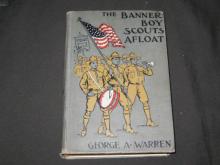
CHAPTER I THE MYSTERIOUS BOXES "What are you limping for, Bobolink?" "Oh! shucks! I see there's no use trying to hide anything from your sharp eyes, Jack Stormways. Guess I just about walked my feet off today, goin' fishin' with our patrol leader, away over to the Radway River, and about six miles up." "Have any luck, Bobolink?" instantly demanded the third member of the group of three half-grown boys, who were passing after nightfall through some of the partly deserted streets on the outskirts of the thriving town of Stanhope; and whose name it might be stated was Tom Betts. "Well, I should say, yes. Between us we got seven fine bass, and a pickerel. By the way, I caught that pickerel; Paul, he looked after the bass end of the string, and like the bully chap he is divided with me;" and the boy who limped chuckled as he said this, showing that he could appreciate a joke, even when it was on himself. About everybody in town called him Bobolink; and what boy could do otherwise, seeing that his real name was Robert O. Link? As the trio of lads were all dressed in the khaki suits known all over the world nowadays as typifying Boy Scouts, it could be readily taken for granted that they belonged to the Stanhope Troop. Already were there three full patrols enlisted, and wearing uniforms; while a fourth was in process of forming. The ones already in the field were known as, first, the Red Fox, to which these three lads belonged; then the Gray Fox, and finally the Black Fox. But as they had about exhausted the color roster of the fox family, the chances were that the next patrol would have to start on a new line when casting about for a name that would stamp their identity, and serve as a totem. An efficient scout master had been secured in the person of a young man by the name of Mr. Gordon, who cheerfully accompanied the lads on their outings, and attended many of their meetings. But being a traveling salesman, Mr. Gordon often had to be away from home for weeks at a time. When these lapses occurred, his duties fell upon the shoulders of PaulMorrison, who not only filled the position of leader to the Red FoxPatrol, but being a first-class scout, had received his commission fromHeadquarters that entitled him to act as assistant scout master to thewhole troop during the absence of Mr. Gordon. "How did you like it up on the Radway?" continued the one who had made the first inquiry, Jack Stormways, whose father owned a lumber yard and planing mill just outside the limits of the town, which was really the goal of their present after-supper walk. "Great place, all right," replied Bobolink. "Paul kept calling my attention to all the things worth seeing. He seems to think a heap of the old Radway. For my part, I rather fancy our own tight little river, the Bushkill." "Well, d'ye know, that's one reason I asked how you liked it," Jack went on. "Paul seemed so much taken with that region over there, I've begun to get a notion in my head he's fixing a big surprise, and that perhaps at the meeting to-night he may spring it on us." "Tell me about that, will you?" exclaimed Bobolink, who was given to certain harmless slang ways whenever he became in the least excited, as at present....

Read online

  • 221

    Boat Club; or, The Bunkers of Rippleton

      Oliver Optic
     Boat Club; or, The Bunkers of Rippleton

AUTHOR'S INTRODUCTION "The Boat Club" was written and published more than forty years ago, and was the first juvenile book the author had ever presented to the public. Young people who read it at the age of eighteen have now reached threescore, and those who read it at ten have passed their half-century of life. The electrotype plates from which it has been printed for more than a generation of human life have suffered so much from severe wear that new ones have become necessary, and they must be replaced. This condition affords the author the opportunity to revise the work, in fact, to make a new book of it; and the old boat must be reconstructed and launched again. The author has something to say on what suggests itself as a memorial occasion when something historical may be said. First, it is proper that old things should be respected and honored, and therefore is presented the— ORIGINAL PREFACE OF "THE BOAT CLUB." The author of the following story pleads guilty of being more than half a boy himself; and in writing a book to meet the wants and the tastes of "Young America," he has had no difficulty in stepping back over the weary waste of years that separates youth from maturity, and entering fully into the spirit of the scenes he describes. He has endeavored to combine healthy moral lessons with a sufficient amount of exciting interest to render the story attractive to the young; and he hopes he has not mingled these elements of a good juvenile book in disproportionate quantities. Thus was laid the foundation of the writer's life-work for young people, after an initiation of over twenty years as a teacher in the schools of Boston, in all grades from usher to principal. Even then he had not the remotest idea of becoming an author; he never definitely prepared himself for such a profession; and, as he has often stated it, he "blundered into the business of writing books for the young," though he had had considerable experience in story-writing for magazines and newspapers. This beginning has been followed by ninety-six volumes in sets of six volumes or more, and two others, the whole of the ninety-eight books being for young people. To these may be added the number of bound yearly volumes of magazines for juveniles of which the writer has been the editor for thirty-two years, making one hundred and thirty volumes of this kind, besides half a dozen or more for adults, to say nothing of nine hundred stories, long and short, for periodicals. This is the literary record of the author in the seventy-fifth year of his age; and being still in fair physical condition, it is possible that more may be added to the number. This is an introduction to the republication of "The Boat Club," and this book suggested what has been written so far. It occurs to me that some venerable person who read the book in childhood may have a desire to know how it happened to be written, and possibly some others may wish to know something of the motives which have animated the writer for the long term in which he has been engaged in producing books for juvenile readers....

Read online

  • 221

    The Vandemark Mummy

      Cynthia Voigt
     The Vandemark Mummy

MUMMY, MUMMY, WHO'S GOT THE MUMMY? It's not a terribly valuable mummy, but its disappearance spells big trouble for Phineas and Althea's father, who is the curator of a small collection of Egyptian antiquities bequeathed to the college where he works. A whispered phone call leads Phineas and Althea to the vandalized mummy without revealing the identity of the thief. Then someone far more important to Phineas than a fifteen-hundred-year-old mummy vanishes. In spite of what the police think, he knows his sister would not have run away, and he knows she's in grave danger. But can he unravel the mystery in time to save her life?

Read online

  • 221

    The Golden Spiral

      Lisa Mangum
     The Golden Spiral

His eyes. His touch. His kiss. Dante was unlike anyone Abby had ever met. Now he’s gone, and Abby will do anything to get him back . . . The hourglass door has closed behind Dante, sending him back in time to hunt down Zo, Tony, and V. When Zo targets Abby's past, she begins building a new time machine "door". With each new change that ripples into her present, Abby's life continues to spiral out of control. As Abby she struggles to free Dante, she receives help from an unexpected - and unlikely - ally.

Read online

  • 221

    Blue Grass Seminary Girls' Vacation Adventures

      Roy J. Snell
     Blue Grass Seminary Girls' Vacation Adventures

Leopold Classic Library is delighted to publish this classic book as part of our extensive collection. As part of our on-going commitment to delivering value to the reader, we have also provided you with a link to a website, where you may download a digital version of this work for free. Many of the books in our collection have been out of print for decades, and therefore have not been accessible to the general public. Whilst the books in this collection have not been hand curated, an aim of our publishing program is to facilitate rapid access to this vast reservoir of literature. As a result of this book being first published many decades ago, it may have occasional imperfections. These imperfections may include poor picture quality, blurred or missing text. While some of these imperfections may have appeared in the original work, others may have resulted from the scanning process that has been applied. However, our view is that this is a significant literary work, which deserves to be brought back into print after many decades. While some publishers have applied optical character recognition (OCR), this approach has its own drawbacks, which include formatting errors, misspelt words, or the presence of inappropriate characters. Our philosophy has been guided by a desire to provide the reader with an experience that is as close as possible to ownership of the original work. We hope that you will enjoy this wonderful classic book, and that the occasional imperfection that it might contain will not detract from the experience.

Read online

  • 220

    Crossed Trails in Mexico

      Roy J. Snell
     Crossed Trails in Mexico

Nell Virginia Fairfax (1884-1956) was an American mystery writer. Under her own name she wrote six mysteries and as Helen Randolph she wrote the Mexican Mysteries for Girls series with her co-author Helen Ripley (1889-1982). Crossed Trails in Mexico finishes the series that began with The Secret of Casa Grande, followed by The Mystery of Carlitos.

Read online

  • 219

    Boy Scouts in an Airship; Or, The Warning from the Sky

      G. Harvey Ralphson
     Boy Scouts in an Airship; Or, The Warning from the Sky

Gates, the United States Secret Service man, closed the door gently and remained standing just inside the room, his head bent forward in a listening attitude. Ned Nestor and Jimmie McGraw, Boy Scouts of the Wolf Patrol, New York City, who had been standing by a window, looking out on a crowded San Francisco street, previous to the sudden appearance of the Secret Service man, turned toward the entrance with smiles on their faces. They evidently thought that Gates was posing, as so many detectives have a silly habit of doing, and so gave little heed to the hand he lifted in warning. The boys knew little about Gates at that time, and so may be pardoned for the uncomplimentary thoughts with which they noted his theatrical conduct. Young Nestor had been engaged by the United States government to undertake a difficult and dangerous mission to South America, and Gates had been sent on from Washington to post him as to the details of the case. The boys had waited at the San Francisco hotel three days for the arrival of the Secret Service man, and waited impatiently, as Sam Leroy, who was to be the third member of the party, was anxious for the safety of his aeroplane, the Nelson, in which the trip to "the roof of the world" was to be made. --This text refers to an alternate Paperback edition. --This text refers to an alternate Paperback edition.

Read online

  • 219